The most common question we get is some version of “a bad address went through, why didn’t you block it?” The answer is almost always the same: that rule was set to Warn, and Warn never blocks. This page explains the two modes so you can set each rule deliberately.
The two modes
Every validation rule runs as Off, Warn after purchase, or Block at checkout. The country and ZIP blocklists are the exception: a listed entry always blocks, no severity to choose.
Block at checkout
Block stops the buyer at the address field, before the order exists. They see your message (each rule’s message is editable in settings), fix the address, and continue. Nobody can complete a checkout that breaks a blocking rule.
One honest caveat: checkout blocks don’t show up in your analytics. Shopify doesn’t report what happens inside the checkout form to apps, so a block leaves no trace we can count. The order that never went wrong is invisible by design.
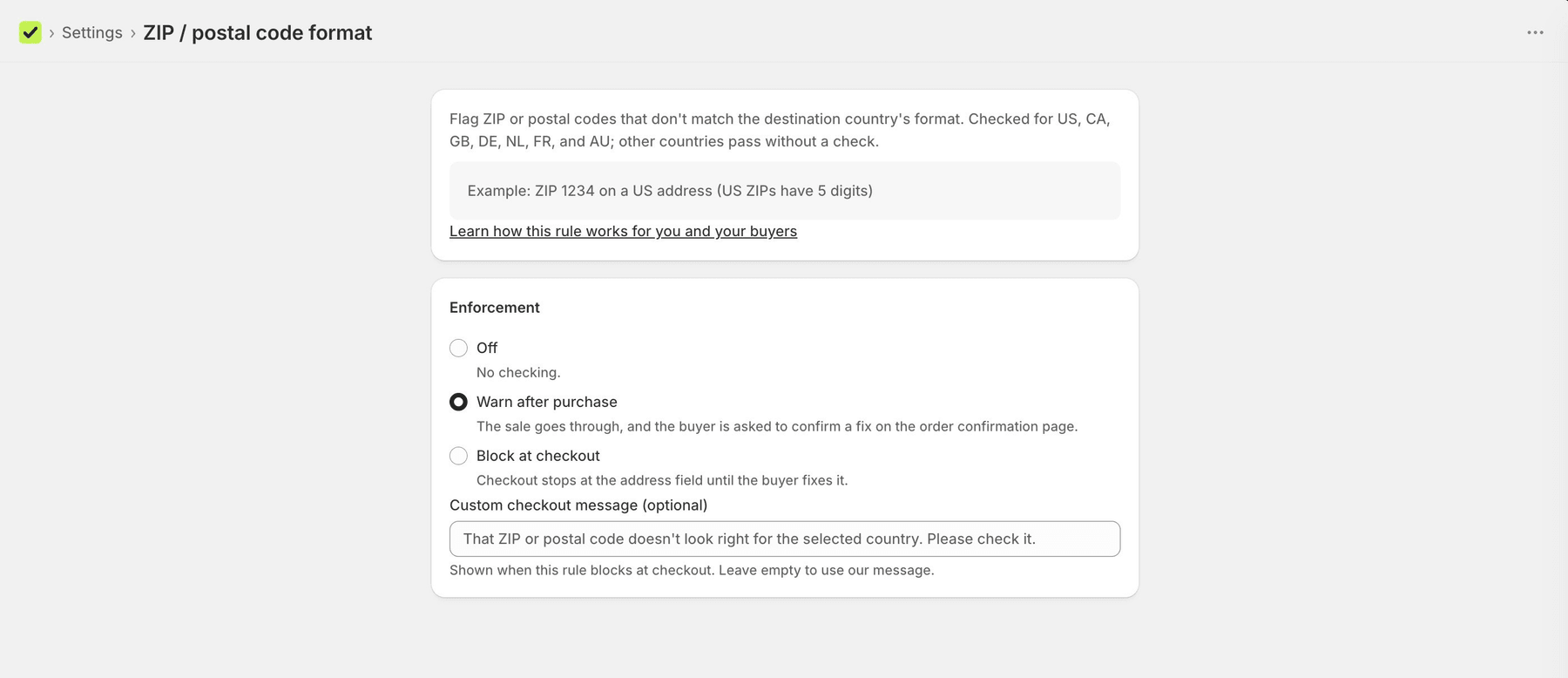
Warn after purchase
Warn never touches checkout. The sale completes, the buyer pays, and on the thank-you page they get one card pointing out the problem. On Pro the card usually carries the corrected address ready to apply; on Free there’s no verification to suggest one, so the card asks the buyer to check the address, with an edit form right there. The same prompt waits on the order status page in case they closed the tab. See what your buyer sees for every state.
Either way, you keep the order. If the buyer accepts the fix, the order is tagged address-corrected. If they don’t, it keeps the tag address-unverified so you can review it before it ships.
Why the defaults are what they are
New installs start with the quality rules (missing house number, ZIP format, unusual characters) on Warn, because a typo shouldn’t cost you a sale. The policy rules (PO Box, military addresses, Packstation, Canadian rural routes) start Off, because whether you ship to a PO Box is your shipping policy, not ours.
How to choose
Block is for addresses you will never ship to. If UPS is your only carrier, a PO Box order is a guaranteed return, so blocking it saves everyone the round trip.
Warn is for addresses that are probably mistakes. A missing apartment number is usually a buyer in a hurry, not a lost cause. Warn catches it without turning the sale away.
And if Address Verifier can’t reach the verification service at all, the order goes through untouched and gets tagged address-unverified. We don’t gamble your checkout on our uptime.